chegg can a two-schema architecture be used instead (explain)? what needs to be changed?

NoSQL databases (aka "non only SQL") are non-tabular databases and store data differently than relational tables. NoSQL databases come in a variety of types based on their information model. The main types are document, key-value, wide-column, and graph. They provide flexible schemas and calibration hands with big amounts of data and high user loads.
In this article, you'll learn what a NoSQL database is, why (and when!) y'all should use i, and how to get started.
Overview
This article will cover:
- What is a NoSQL Database?
- Brief History of NoSQL Databases
- NoSQL Database Features
- Types of NoSQL Database
- Deviation betwixt RDBMS and NoSQL
- Why NoSQL?
- When should NoSQL exist Used?
- NoSQL Database Misconceptions
- NoSQL Query Tutorial
- Summary
- FAQ
What is a NoSQL database?
When people use the term "NoSQL database," they typically employ it to refer to any non-relational database. Some say the term "NoSQL" stands for "not SQL" while others say it stands for "not only SQL." Either way, almost hold that NoSQL databases are databases that store information in a format other than relational tables.
Brief history of NoSQL databases
NoSQL databases emerged in the late 2000s every bit the cost of storage dramatically decreased. Gone were the days of needing to create a complex, difficult-to-manage data model in order to avoid data duplication. Developers (rather than storage) were becoming the primary toll of software development, so NoSQL databases optimized for programmer productivity.
As storage costs apace decreased, the amount of data that applications needed to store and query increased. This data came in all shapes and sizes — structured, semi-structured, and polymorphic — and defining the schema in advance became about impossible. NoSQL databases allow developers to store huge amounts of unstructured information, giving them a lot of flexibility.
Additionally, the Agile Manifesto was ascension in popularity, and software engineers were rethinking the style they developed software. They were recognizing the demand to chop-chop adapt to irresolute requirements. They needed the ability to iterate rapidly and make changes throughout their software stack — all the manner down to the database. NoSQL databases gave them this flexibility.
Cloud computing also rose in popularity, and developers began using public clouds to host their applications and information. They wanted the power to distribute data across multiple servers and regions to make their applications resilient, to calibration out instead of scale upwards, and to intelligently geo-identify their data. Some NoSQL databases like MongoDB provide these capabilities.
NoSQL database features
Each NoSQL database has its ain unique features. At a high level, many NoSQL databases accept the following features:
- Flexible schemas
- Horizontal scaling
- Fast queries due to the data model
- Ease of use for developers
Bank check out What are the Benefits of NoSQL Databases? to learn more than nearly each of the features listed to a higher place.
Types of NoSQL databases
Over time, four major types of NoSQL databases emerged: certificate databases, fundamental-value databases, wide-column stores, and graph databases.
- Document databases store data in documents like to JSON (JavaScript Object Notation) objects. Each document contains pairs of fields and values. The values can typically exist a variety of types including things like strings, numbers, booleans, arrays, or objects.
- Key-value databases are a simpler type of database where each item contains keys and values.
- Wide-column stores store information in tables, rows, and dynamic columns.
- Graph databases store data in nodes and edges. Nodes typically store information most people, places, and things, while edges store information about the relationships between the nodes.
To learn more than, visit Understanding the Different Types of NoSQL Databases.
Difference between RDBMS and NoSQL databases
While a variety of differences exist between relational database management systems (RDBMS) and NoSQL databases, i of the key differences is the style the data is modeled in the database. In this section, we'll work through an example of modeling the same information in a relational database and a NoSQL database. Then, we'll highlight some of the other key differences between relational databases and NoSQL databases.
RDBMS vs NoSQL: Data Modeling Example
Allow's consider an example of storing data about a user and their hobbies. Nosotros need to store a user'south get-go proper name, last proper noun, cell telephone number, city, and hobbies.
In a relational database, we'd probable create 2 tables: one for Users and 1 for Hobbies.
Users
| ID | first_name | last_name | cell | city |
|---|---|---|---|---|
| ane | Leslie | Yepp | 8125552344 | Pawnee |
Hobbies
| ID | user_id | hobby |
|---|---|---|
| 10 | ane | scrapbooking |
| 11 | ane | eating waffles |
| 12 | i | working |
In social club to recall all of the information about a user and their hobbies, data from the Users table and Hobbies table will need to exist joined together.
The data model we blueprint for a NoSQL database volition depend on the type of NoSQL database nosotros choose. Allow'southward consider how to store the same information nearly a user and their hobbies in a certificate database like MongoDB.
{ "_id": 1, "first_name": "Leslie", "last_name": "Yepp", "cell": "8125552344", "city": "Pawnee", "hobbies": ["scrapbooking", "eating waffles", "working"] } In social club to call up all of the information well-nigh a user and their hobbies, a single document can be retrieved from the database. No joins are required, resulting in faster queries.
To meet a more detailed version of this information modeling example, read Mapping Terms and Concepts from SQL to MongoDB.
Other differences betwixt RDBMS and relational databases
While the example in a higher place highlights the differences in data models betwixt relational databases and NoSQL databases, many other of import differences exist, including:
- Flexibility of the schema
- Scaling technique
- Support for transactions
- Reliance on information to object mapping
To learn more well-nigh the differences between relational databases and NoSQL databases, visit NoSQL vs SQL Databases.
Why NoSQL?
NoSQL databases are used in nearly every industry. Utilise cases range from the highly critical (e.g., storing financial data and healthcare records) to the more than fun and frivolous (due east.g., storing IoT readings from a smart kitty litter box).
In the post-obit sections, nosotros'll explore when you should choose to use a NoSQL database and mutual misconceptions about NoSQL databases.
When should NoSQL be used?
When deciding which database to apply, decision-makers typically find one or more of the following factors lead them to selecting a NoSQL database:
- Fast-paced Agile development
- Storage of structured and semi-structured data
- Huge volumes of data
- Requirements for scale-out architecture
- Modernistic awarding paradigms like microservices and real-time streaming
See When to Employ NoSQL Databases and Exploring NoSQL Database Examples for more detailed data on the reasons listed above.
NoSQL database misconceptions
Over the years, many misconceptions almost NoSQL databases take spread throughout the developer community. In this section, we'll discuss two of the most common misconceptions:
- Relationship information is best suited for relational databases.
- NoSQL databases don't support ACID transactions.
To learn more about common misconceptions, read Everything Yous Know Almost MongoDB is Incorrect.
Misconception: human relationship data is best suited for relational databases
A common misconception is that NoSQL databases or non-relational databases don't store relationship data well. NoSQL databases can store relationship data — they just store it differently than relational databases practice.
In fact, when compared with relational databases, many find modeling relationship data in NoSQL databases to be easier than in relational databases, because related data doesn't take to be split betwixt tables. NoSQL data models permit related data to exist nested within a single information structure.
Misconception: NoSQL databases don't back up ACID transactions
Another mutual misconception is that NoSQL databases don't support Acid transactions. Some NoSQL databases similar MongoDB exercise, in fact, back up Acid transactions.
Notation that the way information is modeled in NoSQL databases can eliminate the demand for multi-tape transactions in many employ cases. Consider the earlier example where we stored information about a user and their hobbies in both a relational database and a document database. In order to ensure information about a user and their hobbies was updated together in a relational database, we'd need to employ a transaction to update records in two tables. In order to do the same in a certificate database, nosotros could update a single document — no multi-record transaction required.
NoSQL query tutorial
A variety of NoSQL databases exist. Today, we'll exist trying MongoDB, the globe'south most popular NoSQL database according to DB-Engines.
In this tutorial, y'all'll load a sample database and learn to query it — all without installing anything on your computer or paying annihilation.
Authenticate to MongoDB Atlas
The easiest fashion to get started with MongoDB is MongoDB Atlas. Atlas is MongoDB's fully managed database-as-a-service. Atlas has a forever gratis tier, which is what you'll be using today.
- Navigate to Atlas.
- Create an account if you lot oasis't already.
- Log into Atlas.
- Create an Atlas arrangement and project.
For more information on how to complete the steps above, visit the official MongoDB documentation on creating an Atlas business relationship.
Create a cluster and a database
A cluster is a place where y'all tin store your MongoDB databases. In this section, you'll create a gratuitous cluster.
Once you have a cluster, you tin can begin storing data in Atlas. You could choose to manually create a database in the Atlas Data Explorer, in the MongoDB Vanquish, in MongoDB Compass, or using your favorite programming language. Instead, in this example, you will import Atlas's sample dataset.
- Create a free cluster by following the steps in the official MongoDB documentation.
- Load the sample dataset by following the instructions in the official MongoDB documentation.
Loading the sample dataset will have several minutes.
While nosotros don't need to think about database design for this tutorial, note that database design and information modeling are major factors in MongoDB performance. Larn more about best practices for modeling data in MongoDB:
- MongoDB Schema Design Patterns Blog Series
- MongoDB Schema Design Anti-Patterns Blog Series
- Free MongoDB Academy Course: M320 Information Modeling
Query the database
At present that you have data in your cluster, let's query it! Only similar y'all had multiple ways to create a database, you take multiple options for querying a database: in the Atlas Data Explorer, in the MongoDB Vanquish, in MongoDB Compass, or using your favorite programming language.
In this section, you'll query the database using the Atlas Data Explorer. This is a skilful way to get started querying, as information technology requires zero setup.
-
Navigate to the Data Explorer (the Collections tab), if you lot are not already at that place. See the official MongoDB documentation for information on how to navigate to the Data Explorer.
The left panel of the Data Explorer displays a list of databases and collections in the electric current cluster. The correct panel of the Data Explorer displays a list of documents in the current collection.
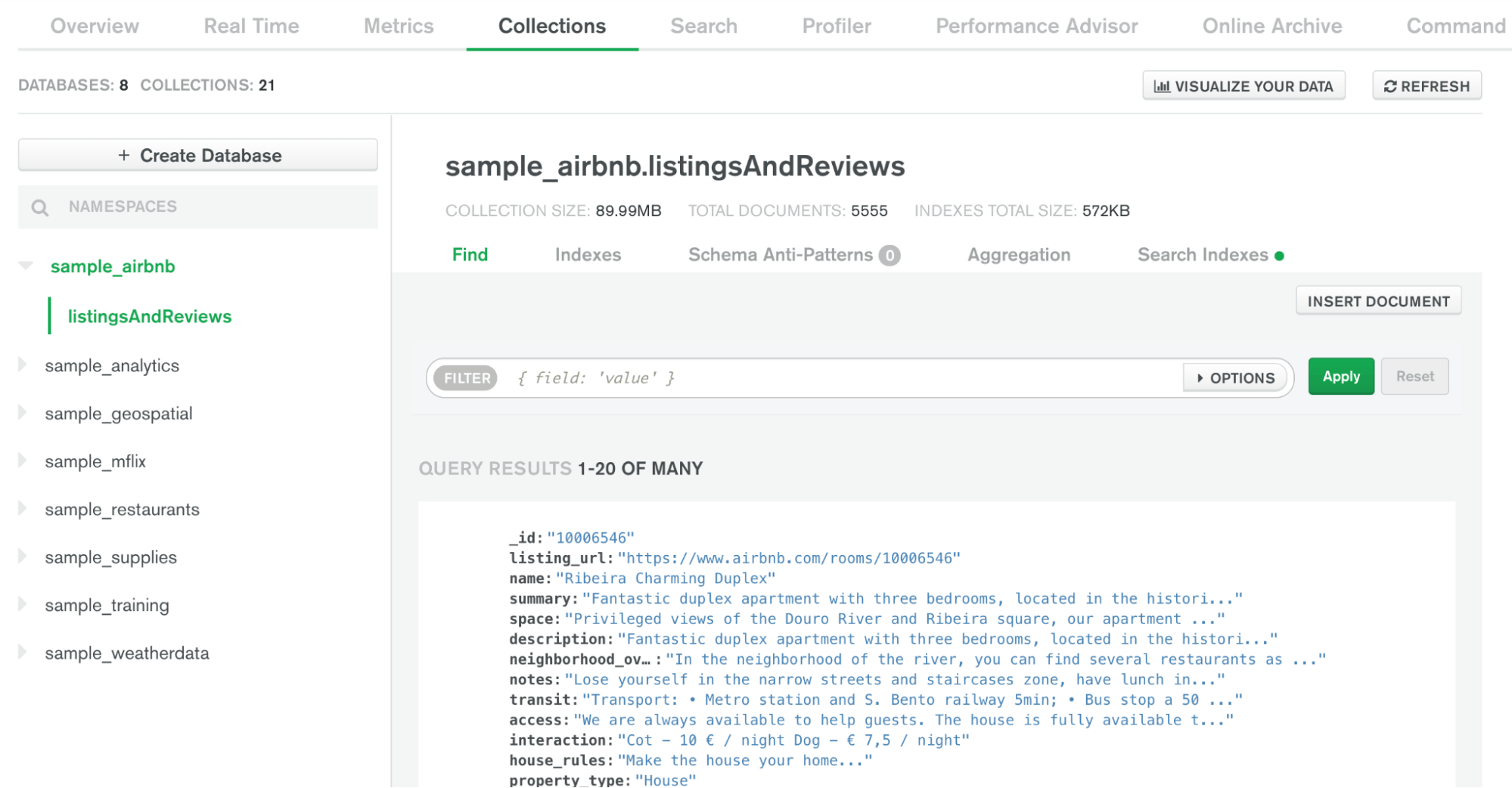
The Data Explorer displays a list of documents in the listingsAndReviews drove.
-
Expand the
sample_mflixdatabase in the left panel. A listing of the database'southward collections is displayed. -
Select the
moviesdrove. The Find View is displayed in the right console. The showtime twenty documents of the results are displayed. -
Yous are now ready to query the
moviescollection. Let's query for the movie Pride and Prejudice. In the query bar, input{ title: "Pride and Prejudice"}in the query bar and click Apply.
-
Ii documents with the title "Pride and Prejudice" are returned.
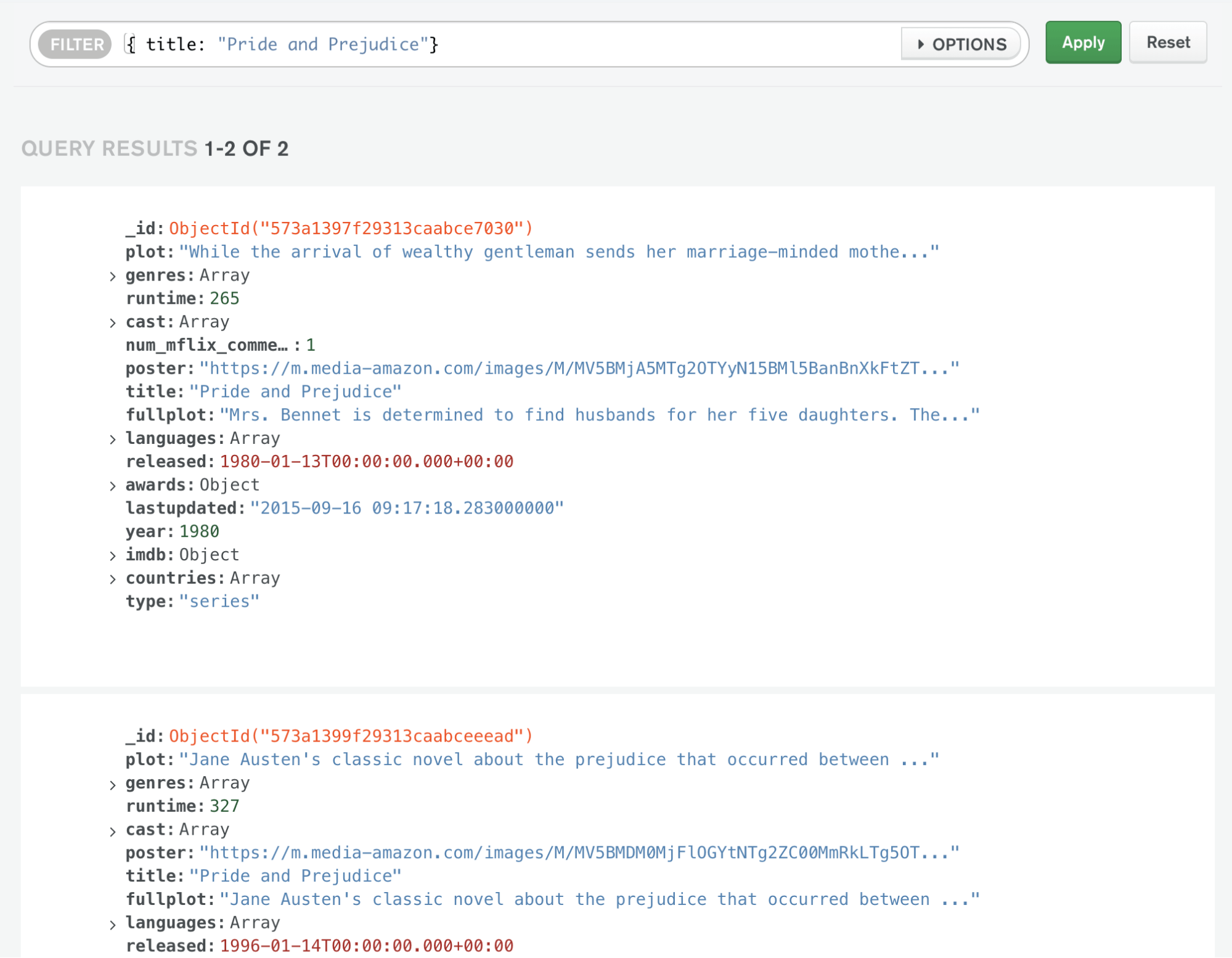 The results for querying for movies with the title "Pride and Prejudice".
Congrats! Yous've successfully queried a NoSQL database!
Go along exploring your data
In this tutorial, we only scratched the surface of what you tin can do in MongoDB and Atlas.
Continue interacting with your data by using the Information Explorer to insert new documents, edit existing documents, and delete documents.
When you are prepare to try more advanced queries that aggregate your data, create an assemblage pipeline. The aggregation framework is an incredibly powerful tool for analyzing your information. To acquire more, take the free MongoDB Academy Course M121 The MongoDB Assemblage Framework.
When y'all want to visualize your information, bank check out MongoDB Charts. Charts is the easiest style to visualize data stored in Atlas and Atlas Data Lake. Charts allows you to create dashboards that are filled with visualizations of your information.
Summary
NoSQL databases provide a multifariousness of benefits including flexible information models, horizontal scaling, lightning fast queries, and ease of use for developers. NoSQL databases come up in a variety of types including document databases, central-values databases, wide-cavalcade stores, and graph databases.
MongoDB is the earth's near popular NoSQL database. Learn more about MongoDB Atlas, and give the complimentary tier a try.
Excited to learn more now that you have your own Atlas account? Caput over to MongoDB University where you can get gratis online training from MongoDB engineers and earn a MongoDB certification. The Quick Start Tutorials are another bully place to begin; they will get y'all upwardly and running rapidly with your favorite programming language.
Follow this tutorial with MongoDB Atlas
Experience the benefits of using MongoDB, the premier NoSQL database, on the cloud.
FAQ
What are the advantages of NoSQL?
What is eventual consistency?
What is the CAP theorem?
What is NoSQL used for?
What is a NoSQL database?
How do I write a NoSQL query?
Is NoSQL difficult to larn?
Is JSON a NoSQL?
What language is used to query NoSQL?
Does NoSQL accept schema?
Source: https://www.mongodb.com/nosql-explained
? what needs to be changed?)
Postar um comentário for "chegg can a two-schema architecture be used instead (explain)? what needs to be changed?"