Google Map V3 Drawing Tools
Project your information on a custom represent using Google My Maps
Tutorial Contents
-
Prerequisites
-
Let's Get weaving!
-
Import your information
-
Style your map
-
Custom-make the points on your represent
-
Modify the style of your base map
-
Edit your map data
-
Label your information
-
Share and embed your represent
-
To share a link to the map:
-
Collaborate with colleagues:
-
Engraft your map:
-
More with Google My Maps
-
Search and filter out your data
-
Add points, lines, polygons and directions to your map
-
Utilisation My Maps on transplantable
-
Discussion and Feedback
-
What's Next
Prerequisites
- No programming skills needed!
- You leave need a Google Account to log in to Google My Maps. Don't have one? Contract here.
Let's Bestir oneself!
In this exercise, we'll Blackbeard you how to import your data, customize the style of your map, and share your map. We'll represent using datasets courtesy of The MAPA Projection and Shark Spotters, featuring the locations of Shark Spotters — trained observers watching the water for sharks — along the False Bay coastline in South Africa, likewise as each reported white shark sightings between September 8, 2012, and February 22, 2013. Your finished map bequeath look like the example supra.
-
Download the two files below, which you will use as sample datasets during this tutorial, and save the files to your desktop:
- sharksightings.csv: This file contains reported white shark sightings between September 8, 2012, and February 22, 2013. Includes beach site, date, time and emplacemen.
- sharkspotter-beaches.csv: This file contains the beach locations where Shark Spotters are stationed, whether it's a permanent operating theater temporary Shark Spotter location, and a short verbal description.
Import your data
-
Log in to your Google describe
-
Go to Google My Maps: https://www.google.com/mymaps
-
In the welcome pop-up, select Create a new map:
-
Click the text Ignoble map to edit the represent title and verbal description. In this character, we've supplied some text under for you to copy and paste into the Represent title panel:
Shark Spotter Sites &ere; Sightings -
Now copy and paste the text below into the Description dialog box:
This represent shows the location of Shark Spotters along the False Bay coastline in Republic of South Africa, as well every bit all reported White shark sightings between Sept 8, 2012, and February 22, 2013. Shark Spotters are positioned at strategic points along the Cape Peninsula. A spotter is placed on the mountain with polarised sunglasses and binoculars. This lookout is in wireles physical contact with other spotter on the beach. If a shark is seen on the beach, the spotter sounds a temptress and raises a special color-coded signal flag, upon which swimmers are requested to leave the water. -
In the menu, select Import:

-
Select the sharksightings.csv from your desktop. This will be the first information layer we upload.
Tip: You can also import a XLSX file or a Google Sheet. You may upload a table containing up to 2,000 rows (see supported data formats and limits here).
-
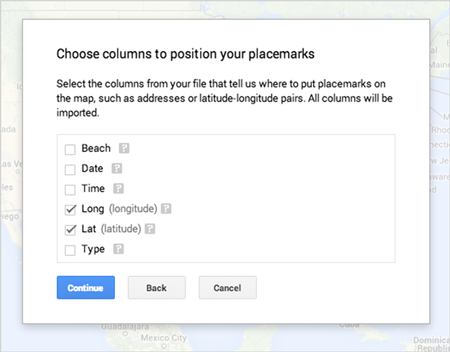
After uploading your data, you'll be asked to select the column(s) with emplacemen information, sol that your information will be correctly placed on the map (e.g. columns with parallel of latitude and longitude information). For this example, select the Latisimus dorsi and _ Long columns_, and hit Continue. You can hover over the question Marks to see sample data from that column.
Tip: If you don't have parallel of latitude and longitude information, you can use addresses in your columns instead.
-
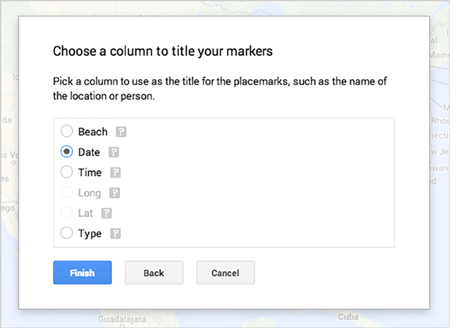
Now cull out the column you'd like to use to title your markers. For this instance, choice the Date column and reach Finish:
-
You should now see your data atomic number 3 a layer in the menu, and your points plotted on the map. If you'd like to change the refer of this level in the menu, just superior the text of the level name (the default will be the file name). For this example, change the layer nominate to Sightings: 9/8/2012 to 2/22/2013.
-
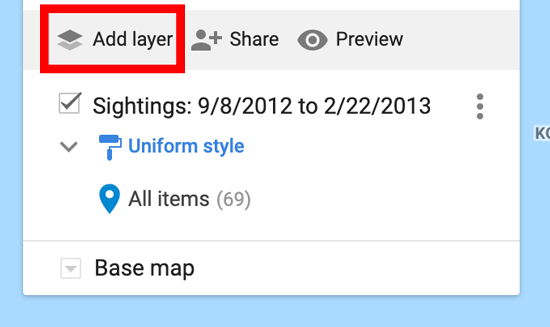
Now let's upload the ordinal data layer. Click Add layer.
Repeat stairs 6 through 9 using the sharkspotter-beaches.csv from your desktop. Prime the Lat and Long columns for your location column, and select the Beach Name chromatography column to title your markers.
-
You should like a sho see both layers visible in your menu and plotted on your map. Select the text of the layer title, and shift the name to Shark Spotter Beaches.

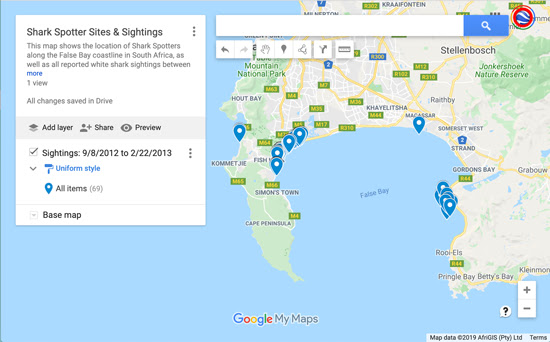

Next, you'll learn how to style the points connected your mapping.
Style your map
Customize the points connected your map
Start past customizing the Sightings level, dynamical the default blue thole to a shark fin icon.
-
Attend the Sightings map layer in the carte du jour.
-
Hover your pointer over the textbook All items (69). You should see a paint can icon appear connected the suitable. Prime the paint can.
-
Selecting the blusher can will draw out up a menu of icon choices, including colours and shapes.
-
Select More icons to see different icon shapes you can choose.
-
Low More icons, choose the shark fin icon
. Now your blue pins should be shark fin placemarks on the represent.


Next, customize the points in the Shark Spotter Beaches data layer. Here you'll bucketful the points into two categories, Permanent Shark Spotter beaches and Temporary Shark Sentry Beaches — information that is already associated with each positioning in the CSV — and use two contrary map icons.
-
Click the Shark Lookout man Beaches layer in the menu and select Individualist styles.
-
Use the Group places past drop-down menu to select Style by data column: Type, then choose Categories.
-
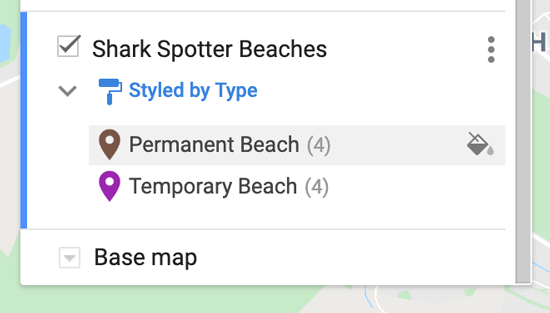
Hover your cursor over the text Permanent, and select the gray blusher can icon that pops up.
Under More icons, select the man icon
. You should directly assure those icons on your map.
-
Hover your cursor ended the text Temporary, and select the gray key lav icon that pops sprouted. Low-level More than icons, choice the walking man icon
. You should now see those icons along your map:



Tip: You can create and add your own icons to the correspondenc. Learn more in the Help Center.
Change the style of your base map
-
In the map menu, go to the Base map layer.
-
Select the carat icon to bald a menu of groundwork map styles.
-
Select a thumbnail to shift the base map style. For this instance, select the thumbnail in the bottom left for Light Landmass.
-
Click anywhere happening the map out to cave in the base mapping menu.

Edit your map data
You can well make changes to your map data at any point in the map-making process. You whitethorn want to do this if you notice a typo operating theater want to add extra selective information to your info Windows. Below you'll learn how to edit your map information.
You've detected a typo in the Muizenberg information in the Shark Spotter Beaches layer. Shark Spotters is misspelled as "Shakspotters".

To blue-pencil the data:
-
Click the pencil icon in the info window. You can edit the data directly from the info window.
-
Alternately, you can prepar changes to your data from within the information table view. In the Shark Spotter Beaches layer, click the layer menu pulldown, indicated by three dots. Select Open data table, and the data table catch bequeath appear:
-
You can draw changes to your information by clicking on any field in the table view:



The table and infowindows for your map locations are synchronized, so whatever changes you make wish be reflected in both places. You can besides add rows to your table if you want to expose additional entropy, operating room delete an existing row.
Tip over: If you shift the content within a location column, it will automatically attempt to rectify the location according to your changes on the map.
Label your data
You can make labels or "titles" appear next to the features on your map using the Label feature. The label of your feature will equal confiscate from a column in your data that you specify.
-
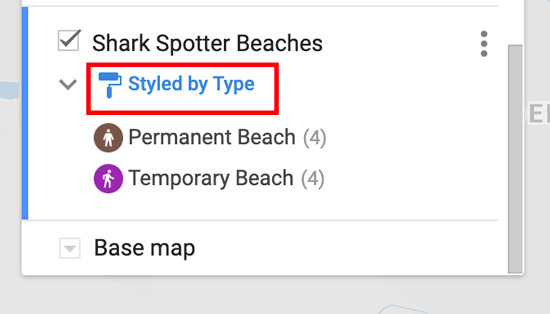
In the Shark Spotter Beaches layer in the menu, click on Styled aside character:
-
From the Adjust labels drop-down menu, prize Beach Name:
-
Straightaway you should see the points in your Shark Spotter Beaches data labelled with its corresponding Beach Key out:


You consume many options when you want to share your map with others. All maps are private past default — only you as the creator of the map tush view or edit it. Below you'll learn how to make the map public and embed it on your website, American Samoa advantageously as how to cooperate on your map with colleagues.
- Sink in the Share release in the map fare.
-
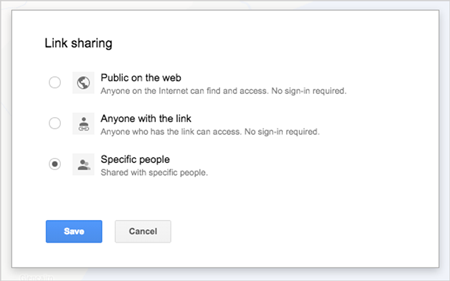
Under "Who has access", select Change and you'll be minded options to either leave the represent "Specific people" (or cliquish), "Anyone with the link" or "Public on the web".
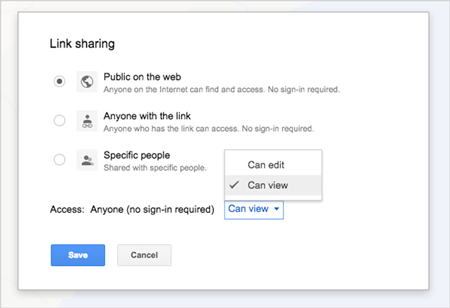
If you prefer to make your map Public along the web, you'll be able to further refine your share settings to make your map either just viewable or editable aside the public.
Baksheesh: Sharing your represent with a person who has a not-Google account? Copy the map URL and change the word "redact" in the URL to "view" before sending -- then no login will be required.
Collaborate with colleagues:
- Click the Share button in the map card.
-
Under "Tot people" at the bottom of the menu, type in the e-mail addresses of the hoi polloi you'd corresponding to partake your mapping with directly, or prefer from your contacts. You terminate select whether the masses you invite can edit the map Oregon just view information technology.

Tip: You can chop-chop add together multiple collaborators to your map by sharing your map with a Google Group. Apiece member of chemical group will have got access to your map, and if you ADD sunrise people to the group, they'll have access too.
Embed your map:
- First, make a point your map is State-supported connected the vane. Share button > Who has access > Deepen > Public on the web > Save.
- Get over back to your map and select the mapping menu pulldown, indicated by three dots next to the Partake in release.
- Select Imbed on my site.
-
Copy the HTML and library paste IT into the source cypher of your website. Annotation that you can customize the height and breadth of your map.

Tip: You force out set a default view for the map. This gives you extra control condition over what luck of the represent will get on expose when a viewer first visits your correspondenc. To set this feature, position the correspondenc in your browser. Then go to the map menu pulldown, indicated by three dots next to the Apportion button, and take Pose default regar.
Congratulations! You bear learned how to import data, customize styles and share your map victimisation Google My Maps.
Thomas More with Google My Maps
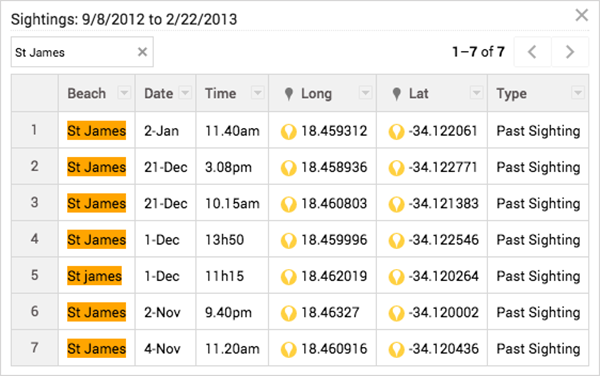
Search and filter your data
In the Sightings layer, move out the level menu pulldown, indicated by three dots, and select Loose data table:

Use the search loge to search and filter through this data:
Add points, lines, polygons and directions to your map out
Hand-suck points, lines and polygons connected your mapping with the drawing tools. Click the hand icon to stop drawing. You can also carry through drive, bicycling or walking directions to the map out. Use the ruler icon to measure distances and areas.

Use My Maps on mobile
There are many ways you can access and edit out My Maps connected the go: view and edit maps in the My Maps app; view and edit maps on your mobile browser; or just view them in Google Maps for changeable.

Word and Feedback
Have questions about this tutorial? Want to pass on us some feedback? Confab the Google Earth Help Community to talk over IT with others.
What's Next
- Travel to germane Help articles to learn more about Google My Maps..
- Undergo all tutorials.
Source: https://www.google.com/earth/outreach/learn/visualize-your-data-on-a-custom-map-using-google-my-maps/
Postar um comentário for "Google Map V3 Drawing Tools"